
When we opened our doors in Fell's Point twenty-nine years ago, pouring Greek wine was an act of faith.
Guests would ask for something familiar, and we would ask for something in return: one glass. One glass of Assyrtiko, or Agiorgitiko, or Xinomavro — names that did not roll off the tongue, from places most wine lists had never heard of. We poured, and we told the story. We have been pouring and telling ever since.
The faith was noticed early. In October 2000, Baltimore Magazine put a much younger Dimitris on its cover, glass in hand — "salut! We toast top restaurant wine lists" — back when championing Greek wine in America still raised eyebrows. And standing beside him on that cover was a bottle from Nico Lazaridi: the first Greek wine ever featured in prominence on the cover of an American magazine. When word reached the winemaker himself, Nico was thrilled — a bottle from his cellars, on a magazine cover an ocean away, announcing what we had been saying all along. We have kept those magazines. We have kept the conviction, too.
Today, no faith is required. The wines of Greece are asserting their position among the finest in the world — in the great cellars, on the great lists, in the hands of a new generation of winemakers who understand exactly what they have inherited. What they have inherited is this: the oldest continuous wine culture on earth.
Older than the word "wine" itself
Homer wrote of wine the way other poets wrote of gods. The "wine-dark sea" of the Odyssey. The Pramnian wine mixed for heroes. When the Greeks planted vines on their islands and mountainsides, Rome did not yet exist. These are varietals with a history stretching thousands of years before Christ — not revived curiosities, but living lineages. The Assyrtiko in your glass descends from vines the ancients knew.
And here is the miracle: in some of Greece, that descent was never broken. When phylloxera devastated the vineyards of Europe in the nineteenth century, forcing nearly every great wine region to replant on American rootstock, the volcanic sands of Santorini refused the pest. The vines there grow ungrafted — on their own roots, as vines grew in antiquity — some root systems centuries old, trained into low woven crowns against the Aegean wind. To drink Santorini is to taste something continuous with the ancient world. Almost nowhere else on earth can make that claim.
One country, every terroir
What makes Greece extraordinary is not one region but the impossible variety of them. Volcanic ash on Santorini. Limestone in the Peloponnese. Alpine slopes in the north, sun-scorched islands in the south, and every elevation and microclimate between — all in one country smaller than the state of Alabama.
In the north, in Naoussa and up toward Florina and Amyndeon, Xinomavro grows at elevation in a climate closer to Burgundy than to the postcard Greece of white villages — and it ages like the great Nebbiolos of Piedmont, all rose petal, tomato leaf, and firm noble structure. In our cellar right now: Kir-Yianni's Ramnista, a single-vineyard Xinomavro from Naoussa, and — proof of how far this region reaches — their high-altitude Assyrtiko called The North, Santorini's island grape thriving in the mountains of Florina. From the Amyndeon plateau nearby comes Alpha Estate's single-vineyard Malagouzia, from the vineyard they call Turtles: an aromatic white grape that had nearly vanished within living memory, now among the most seductive things Greece pours.
In the Peloponnese lies ancient Nemea, where Herakles slew the lion and where Agiorgitiko has grown since the days when athletes competed at the sanctuary. Velvet-deep, generous, unmistakably Greek — we devoted an entire evening to these wines with our friend Dimitris Skouras, and could devote many more. From the Skouras cellars we pour their wild-ferment Assyrtiko, grown at 620 meters of elevation, and Zoe — "a tree of life" — the rosé that carries the Peloponnese into summer.
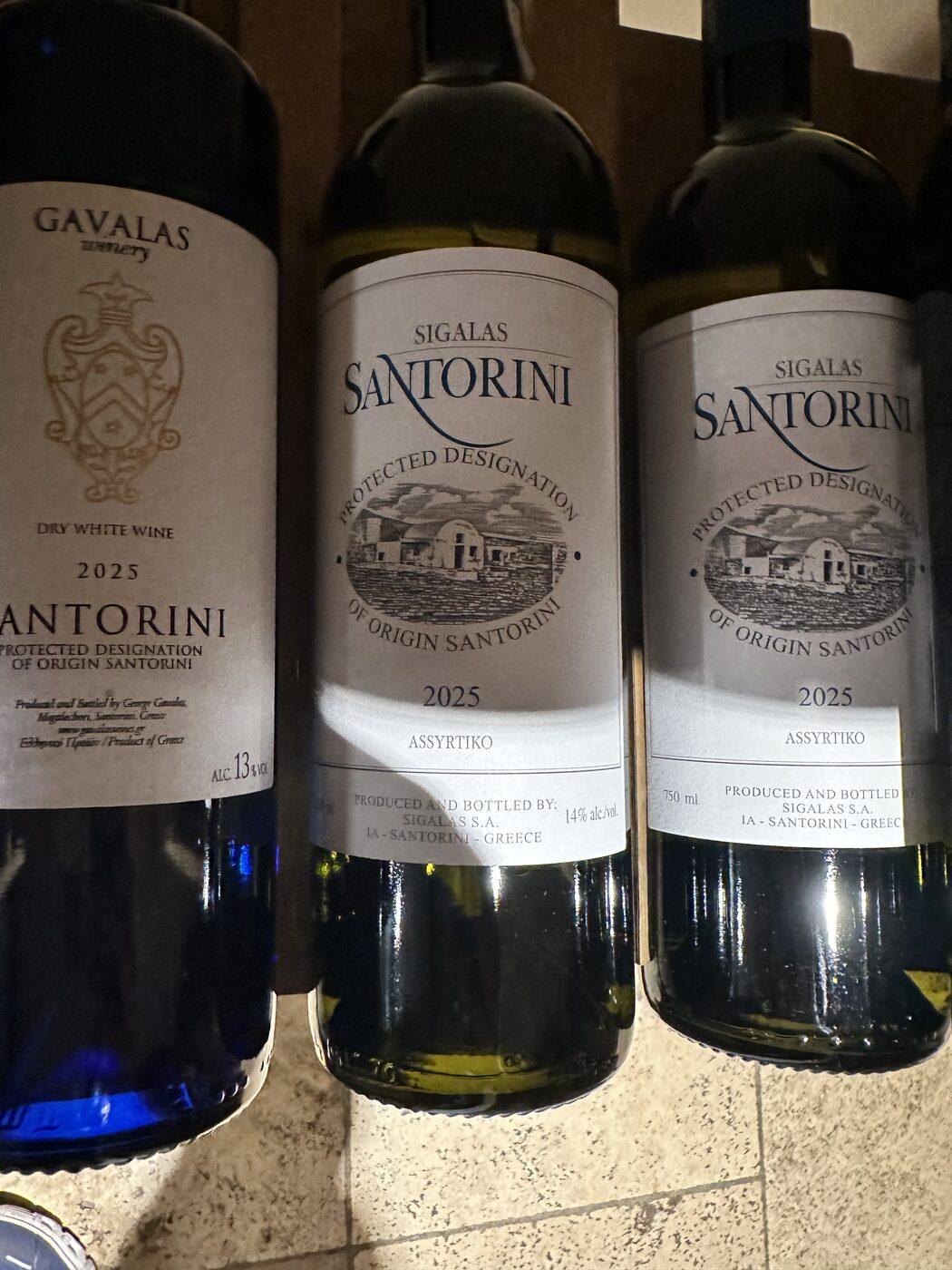
On Santorini, Assyrtiko drinks the sea: bone-dry, saline, electric with acidity, grown in volcanic soil that gives the wine a mineral spine no other white in the Mediterranean possesses. We pour the island in all its voices: Sigalas of Oia — both the pure Santorini Assyrtiko and Nychteri, the old style once made in a single night's work at harvest; Gavalas of Megalochori, a family winery generations deep, whose own Nykteri rests six months in barrel; and Vassaltis, the island's young guard, whose Mavrotragano — Santorini's rare red, pulled back from the edge of extinction — comes to us in individually numbered bottles.
And on Crete — one of our great joys of recent years — old varietals like Vidiano and Liatiko are being rescued from near-oblivion by small producers who farm mountain vineyards their grandparents planted, making wines of remarkable perfume and freshness at the crossroads of the ancient world.
Small production, great conviction
The wines we bring to Baltimore are not industrial. Most come from families and small estates — a few thousand cases, sometimes a few hundred — made by people we know by name, many of whom have sat at our tables. Take one bottle resting in our cellar tonight: Vassaltis Mavrotragano 2022, stamped by hand — Bottle No. 1649. When a winemaker counts every bottle, you are not buying a product. You are being handed a share of something finite.
These are winemakers, not wine factories: growers who kept faith with indigenous grapes when the market begged them to plant Chardonnay, and who are now vindicated as the world comes searching for exactly what they never abandoned.
This is why we say Greece is returning to the top of the winemaking world. Not arriving — returning. The country that taught Europe to make wine is reclaiming its seat at the table, bottle by bottle, from Crete to Florina, Santorini to Naoussa, and ancient Nemea.
Taste the journey
For twenty-nine years, our family has served as a bridge between those vineyards and this harbor city. You will find these wines throughout our list, in our Santorini flights, and at our winemaker dinners around the long table in our brick-vaulted cellar, where thousands of bottles rest in the walls around you — including our Greek Wine Dinner on Wednesday, August 26, a journey glass by glass across the regions in a single evening.
Come take the long way home with us. It begins with one glass.
